

Undergrads use campus as living laboratory to investigate root microbiomes
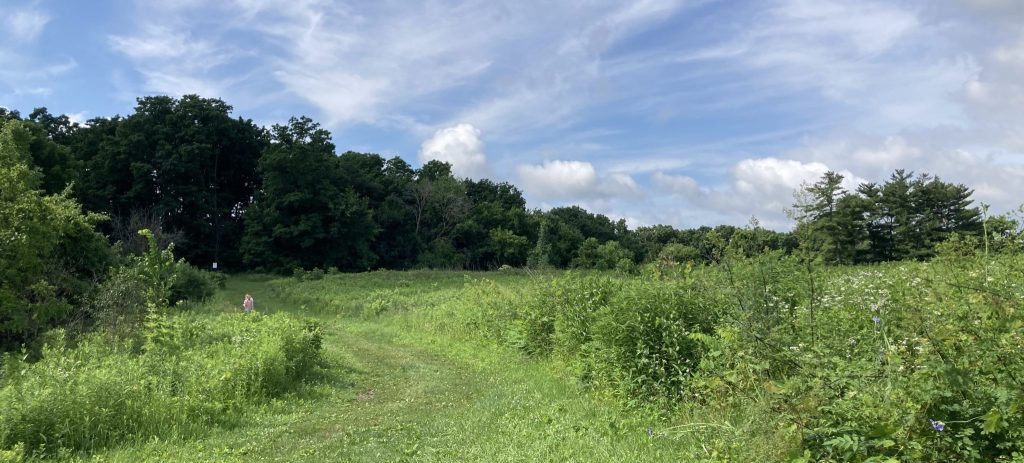
The UW–Madison campus is home to more than its students, faculty, and staff. The campus’s many natural areas, such as the UW Arboretum and the Lakeshore Nature Preserve, provide important habitats above and below ground to plants, animals, and microbes. They also serve as living classrooms and laboratories. Last summer, undergraduate students embarked on new research in the Nature Preserve, harvesting, observing, and identifying bacteria living in root systems of two grasses native to Wisconsin.

The undergraduate-led research project was initiated by Christine Hustmyer, then a postdoctoral researcher working with biochemistry professor Robert Landick. Hustmyer was inspired by her Biology Core Curriculum (Biocore) students to explore research possibilities in the Lakeshore Nature Preserve.
“The project arose from Christine’s vision to introduce new students to the excitement of scientific research,” says Landick.
“I really fell in love with the Nature Preserve when I was watching undergraduate students in Biocore grow to know that space,” recalls Hustmyer, who also completed her doctoral studies with Landick and is now a professor at Beloit College.
Her students were interested in the different communities of bacteria found in diverse plant populations. Within the scope of their Biocore coursework, however, they didn’t have the time to engage in deeper biochemical analysis, including determining the microbes’ DNA sequences, how those microbes respond to chemical compounds, and how microbial composition affects plant health.
To address these questions, Hustmyer and Landick applied for and received a 2025 Lakeshore Nature Preserve Student Engagement Grant. They had two goals in mind: to learn more about the impact of plant microbiomes on biofuel-relevant native plants, and to provide opportunities for students who were exploring research careers but didn’t have research experience. The grant supported a four-week summer project for two students.

Undergraduate students Alaynah Smith, a biochemistry major who had just finished her junior year, and Alex Taylor, then a rising sophomore studying environmental engineering, were hired as the project’s inaugural summer researchers.
Smith and Taylor, both interested in learning more about the ins and outs of the scientific research process, were chosen from dozens of applicants for their curiosity, collaborative spirit, and drive to try something new.
“I had never done fieldwork before. I would like to pursue graduate school, but first I wanted to see what research was all about,” says Taylor, who came to UW–Madison after working in the retail sector for several years after high school.
In June 2025, they began with field work, where they learned to identify switch grass and big bluestem and make observations about the plants and the surrounding environment.
Soil and plant samples in hand, Smith and Taylor brought life from the Lakeshore Nature Preserve into the research lab. Working in the Landick Lab, they plated and grew bacteria, added a compound found in plant roots to quantify their impact on microbial communities, and learned techniques to harvest and sequence DNA. Though this process can be expensive, the team was able to stretch grant funds using kits donated by Zymo Research.
The results revealed that Smith and Taylor captured more than one hundred bacterial species from soil surrounding the roots of their collected plants, highlighting the incredible diversity of the plants’ native microbiome.
The study also helped Smith and Taylor develop new skills as scientists. “With the structure and support provided by Christine, I learned how to form my own questions and make scientific observations while building on my lab skills and ability to present the results of these findings to a larger audience,” says Smith, who hopes to apply her scientific education to community-focused work after she graduates.
“I learned the collaborative nature of research and how it provides a great way to bring about positive change within local communities,” says Taylor. “Programs aiming to provide people with their first research experience can provide a great way to garner interest in the research community, which is what I believe makes them so vital.”

Hustmyer intends to see Smith and Taylor back next summer to build on the first year’s findings and help mentor two new summer researchers. The team will repeat the field study and test a wider variety of conditions in the lab to identify impacts of plant-produced compounds on the soil microbiome. The project, Hustmyer hopes, will grow to become a long-term partnership between UW–Madison and other undergraduate-only institutions.
“[The project’s] success promises to grow in the years ahead and is a testament to the phenomenal PhD students who train at UW–Madison,” says Landick, “and to their broad impact on our central mission to deliver the benefits of science to the people of Wisconsin.”
“We can do interesting science while giving students experiences in field work, lab research, and data analysis,” says Hustmyer. “Eventually we’d like to expand to testing additional root compounds and see how they affect the microbiome and biochemical composition of the roots. How do changes in the soil impact these plants? It’s really compelling for both the biofuel field and for studying native ecology.”
Written by Renata Solan.