

New faculty profile: Michael Belitz studies how global changes impact insect populations
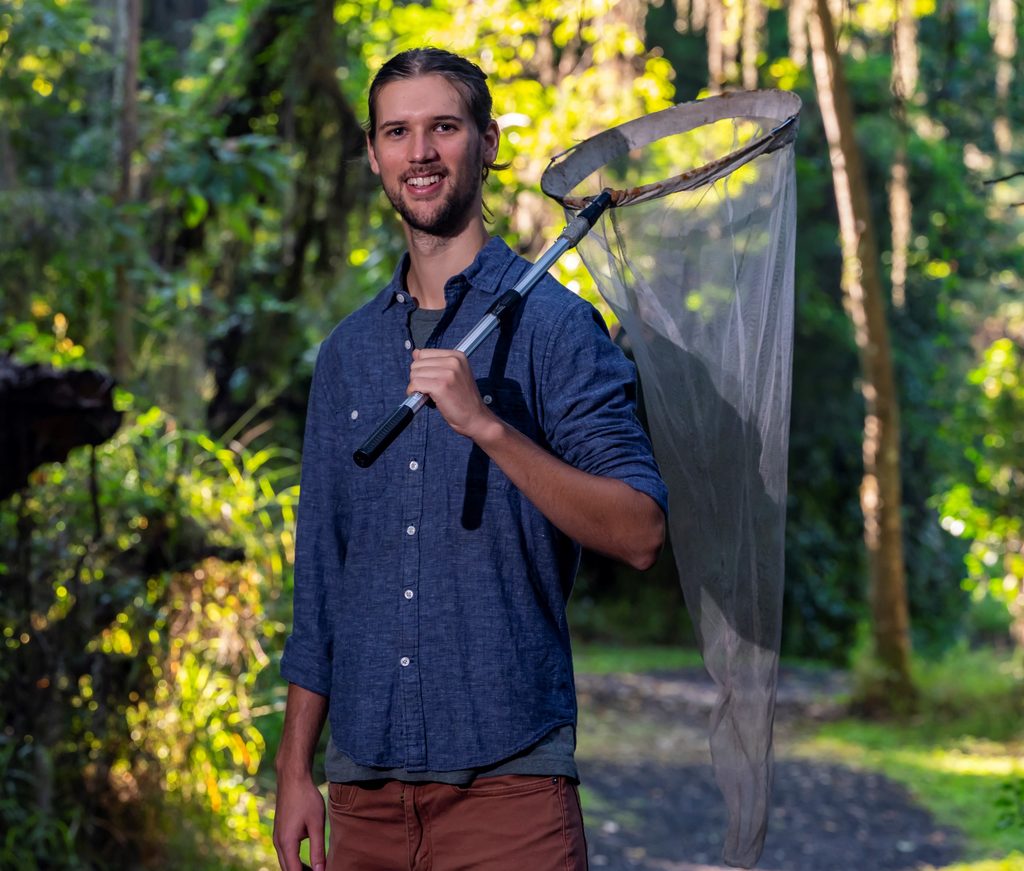
Michael Belitz joined the UW–Madison faculty in August 2026 as an assistant professor in the Department of Entomology. His position is part of RISE-EARTH, the sustainability-themed focus area of the university’s Wisconsin RISE Initiative strategic hiring effort to solve grand challenges.
What is your hometown? Where did you grow up?
I grew up in Cleveland, Wisconsin, a small village between Manitowoc and Sheboygan. I’m incredibly excited to be back in my home state.
What is your educational/professional background, including your previous position?
I earned my bachelor’s degree in biology and environmental studies at Knox College and my master’s in biology at Central Michigan University. I then completed my PhD in zoology at the University of Florida, where I worked at the Florida Museum of Natural History. Before joining UW–Madison, I was an NSF postdoctoral research fellow in Biology, co-mentored by researchers at Michigan State University and the University of British Columbia.
What is your field of research, and how did you get into it?
I’m a global change entomologist. I use ecoinformatics approaches to understand how insects are responding to environmental change across broad spatial, temporal and taxonomic scales. I’ve been drawn to the outdoors and to watching how organisms interact in nature for as long as I can remember, which led me to field ecology and conservation biology. During my master’s, I was introduced to natural history collections and biodiversity informatics, and to the enormous treasure trove of biological data that collections hold. That sparked something in me, and I wanted to bring together the huge and growing amount of biodiversity data, such as data collected by participatory scientists on platforms like iNaturalist and eBird to specimens being digitized by museums, to better understand how biodiversity responds to global change.
What are the main goals of your current research program?
My lab studies how insects respond to climate change, urbanization and agricultural intensification, with the goal of informing conservation and climate adaptation. We have a number of main goals. We aim to understand which insect species are declining, where and why, including how extreme weather and agricultural intensification affect insect populations, so that conservation can target whole groups of at-risk species. We are measuring how insect timing and body size shift with changing climates and urban development, using tools like computer vision to measure hundreds of thousands of museum specimens. We want to understand the large-scale patterns and processes that shape insect diversity. By combining data from national monitoring networks, museum collections and participatory science, we ask how insect communities and traits vary across continents and whether insects can serve as indicators of the health of entire ecosystems.
What was your first visit to campus like?
My first visit to campus was a while ago. I believe it was an eighth-grade school trip for a history project. As a kid from rural Wisconsin, I was pretty intimidated by the hustle and bustle of Madison. Now I love how lively campus is, and I find it really inspiring.
What classes do you teach?
I teach courses on using data tools, ecoinformatics, and causal inference in global health and entomology. I want students to leave feeling empowered to make data-informed decisions in policy and management.
What’s the most important lesson you wish to convey to students?
Environmental challenges are real and pressing, but they aren’t the fault of individuals, and they aren’t hopeless. Collective action, creativity and passion can help solve them.
Do you feel your work relates to the Wisconsin Idea? If so, how?
Yes. I strive for my research to be useful to stakeholders and practitioners across the state and beyond. By understanding how insects respond to extreme weather, land-use change and agriculture, my lab aims to give land managers, conservation groups, and agencies the evidence they need to protect insects and the ecosystem services they provide, such as pollination and pest control. Being able to do that work in the state where I grew up makes it especially meaningful. Additionally, much of my research depends on data shared by the public. Every time someone posts an observation to iNaturalist, they’re contributing to our understanding of how biodiversity is changing, and I’m excited to work with naturalists, students, and community members across Wisconsin to grow that knowledge.
What’s something interesting or surprising about your area of expertise that will make us sound smarter at parties?
All butterflies are moths! Butterflies are a group of mostly day-flying moths that share a common ancestor, nested within the larger order Lepidoptera.
What are your hobbies and other interests?
I like using iNaturalist to fill in my observation map and find new species. I also enjoy hiking, camping, kayaking, and watching baseball.